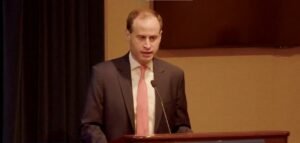
Treasury Secretary Scott Bessent said financial institutions reported more than $2.5 billion in suspicious activity tied to payroll tax fraud schemes in 2025, connecting the issue to illegal employment, identity theft, shell companies and transnational criminal networks.
Speaking at an event with Texas bankers in Houston, Bessent said the Treasury Department is expanding efforts to detect and disrupt financial schemes linked to unlawful employment practices. He argued that the activity hurts legitimate businesses, lowers wages, steals taxpayer money and creates opportunities for criminal organizations to move illicit proceeds through the financial system.
The remarks followed a recent advisory from the Treasury Department’s Financial Crimes Enforcement Network, known as FinCEN, warning banks and other financial institutions to watch for signs of fraud involving non-work-authorized populations. The advisory focuses on payroll tax evasion, identity theft, money laundering, labor brokers, shell companies and employers who may be using off-the-books payments to hide illegal hiring.
“In 2025 alone, financial institutions reported more than $2.5 billion in suspicious activity associated with payroll tax fraud schemes,” Bessent said. He added that those schemes can harm workers, taxpayers and law-abiding employers.
TRENDING TODAY


The Treasury secretary framed the issue as both an economic and national security problem. He said criminal groups and cartels may exploit unlawful employment systems to generate and move money, while legitimate businesses face unfair competition from companies that evade taxes or workers’ compensation rules.
The FinCEN advisory does not declare every flagged transaction to be illegal. Instead, it identifies warning signs that may indicate suspicious activity and asks financial institutions to review customer behavior based on risk. Banks are already required to file suspicious activity reports when they detect patterns that may involve money laundering, fraud or other financial crimes.
Bessent emphasized that the guidance is not intended to turn banks into immigration enforcement agencies. He said banks should focus on what they already do: know their customers, identify risk, recognize suspicious patterns and report possible illicit activity when appropriate.
That distinction is important because the advisory has drawn concern from immigrant-rights advocates and some banking groups. Critics warn that guidance tied to immigration status could discourage undocumented workers and mixed-status families from using banks, pushing more people into cash-only systems that are harder to monitor and more vulnerable to exploitation.
Supporters of the policy argue that payroll tax fraud is a serious problem that can involve identity theft, wage theft and tax evasion. They say employers and labor brokers who use unauthorized workers off the books can gain an unfair advantage over companies that follow labor and tax laws.
FinCEN’s advisory highlights several possible red flags. These include companies with payroll activity that does not match their stated business purpose, sudden changes in payroll patterns, shell companies connected to labor brokers, use of mismatched identification information, and activity suggesting that workers are being paid outside normal payroll systems.
The advisory also warns that some schemes may involve the misuse of Social Security numbers or other personal information belonging to U.S. citizens or lawful residents. In those cases, identity theft can become part of a broader employment fraud operation.
Treasury officials say community banks can be especially important in detecting suspicious patterns because they often know local businesses and can spot changes before they appear in national data. Bessent told bankers that local financial institutions are a “critical line of defense” against financial crime.
The updated guidance also allows financial institutions to share more information with one another when trying to detect fraud. The Treasury Department says faster information-sharing can help banks identify networks of shell companies, suspicious payroll activity and possible money movement tied to criminal organizations.
The effort is part of the Trump administration’s broader push to connect immigration enforcement with financial crime enforcement. The administration has argued that illegal employment is not only an immigration problem but also a fraud, tax and national security issue.
Opponents argue that the administration is using financial regulation to expand immigration enforcement indirectly. They worry banks may overreport customers who use Individual Taxpayer Identification Numbers or foreign documents, even when those customers are not involved in fraud.
FinCEN has said red flags should not be used in isolation and that financial institutions should consider the full context of customer activity. A single indicator does not prove wrongdoing. Banks are expected to use risk-based judgment before filing reports.
The debate reflects a broader policy question: how can the government crack down on genuine labor exploitation and payroll fraud without discouraging vulnerable workers from accessing financial services?
Illegal employment schemes can harm workers as well as taxpayers. Workers paid off the books may be denied overtime, workers’ compensation, unemployment protections or safe working conditions. Some may also be vulnerable to coercion from labor brokers or employers who use immigration fears to silence complaints.
At the same time, aggressive financial monitoring can create risks if legitimate customers are treated as suspicious because of immigration status, language, documentation type or industry. That is why civil liberties groups and financial institutions are likely to watch how the guidance is enforced.
Bessent said the administration will continue working with banks, regulators and law enforcement to target fraud while protecting the financial system. He described economic security as national security and said the White House Task Force to Eliminate Fraud, led by Vice President JD Vance, is supporting the broader effort.
The next phase will depend on how banks respond to the advisory and whether suspicious activity reports lead to investigations, prosecutions or enforcement actions against employers, labor brokers and shell companies.
For now, Treasury is sending a clear message: payroll tax fraud tied to illegal employment is becoming a major focus for federal financial enforcement.
Why It Matters
This matters because suspected payroll tax fraud affects taxpayers, workers and businesses. Employers that evade payroll taxes or pay workers off the books can undercut legitimate companies and deny workers basic protections.
It also matters because the policy puts banks in a larger role in immigration-linked financial crime enforcement. Supporters say that will help detect fraud and cartel-linked activity, while critics warn it could discourage vulnerable communities from using the banking system.
What Comes Next
Banks and financial institutions will review FinCEN’s advisory and may increase reporting of suspicious payroll and employment-related activity. Federal investigators could use those reports to target employers, labor brokers or shell companies suspected of tax evasion, identity theft or money laundering.
The policy may also face scrutiny from immigrant-rights groups, banking associations and lawmakers concerned about privacy, fair access to banking and the risk of overreporting.
Treasury officials have also expanded FinCEN scrutiny of suspicious money flows as part of a broader push against fraud, money laundering and illicit financial networks.
🚨 JUST IN: Scott Bessent announces geographic targeting order for the MINNEAPOLIS-ST. PAUL area after money was wired to the Middle East, to ensure rapid prosecution of illegal activity and fraud
FinCEN will now HEAVILY scrutinize money being sent: “This will put a microscope… pic.twitter.com/aIzr3q0kYm
— Eric Daugherty (@EricLDaugh) January 9, 2026