

China’s carefully staged welcomes for President Donald Trump and Russian President Vladimir Putin appeared almost identical on the surface, but the details showed subtle differences in how Beijing handled the two powerful leaders.
Just days after Trump was greeted in Beijing with a military band, an honor guard and children waving American and Chinese flags, Putin arrived to a similar ceremony featuring the same kind of pageantry.
The choreography of the two visits appeared deliberately mirrored. China seemed eager to show that it could host both Washington and Moscow with equal confidence, ceremony and global attention.
Both visits took place at a sensitive moment in international politics, as China tries to manage tense relations with the United States while deepening its strategic partnership with Russia.
TRENDING TODAY


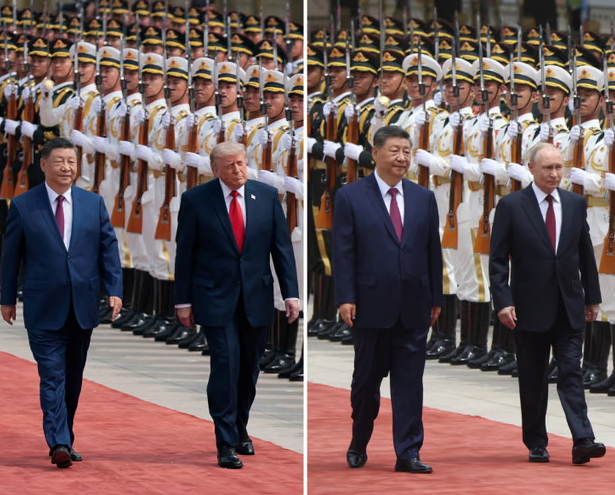
Trump’s visit focused heavily on trade, investment, Taiwan, Iran and broader U.S.-China competition. Putin’s visit, meanwhile, highlighted Beijing and Moscow’s growing alignment on energy, technology, trade and opposition to Western pressure.
Although the ceremonies looked similar, analysts noted that China appeared to send different signals through the officials chosen to greet each leader.
Trump was met at the airport by China’s vice president, a role that carries public importance but limited real power inside the Communist Party’s core decision-making structure.
Putin, by contrast, was reportedly welcomed by a sitting member of the Politburo, one of the most powerful bodies in China’s political system.
That difference was viewed by some observers as a quiet signal that Beijing sees Moscow as a more trusted long-term partner in its effort to build a non-Western global order.
The Kremlin appeared aware of the comparisons. Russian officials rejected suggestions that Putin’s visit should be measured directly against Trump’s, saying the meeting with Xi Jinping had been planned well before Trump’s trip to Beijing.
Kremlin spokesperson Dmitry Peskov argued that the substance of the visit mattered more than ceremonial comparisons.
The timing still made the contrast difficult to ignore.
By hosting Trump and Putin within days of each other, Xi placed China at the center of global diplomacy and showed that Beijing can engage both America’s president and Russia’s leader on its own terms.
For China, the message was clear: it wants to be seen not only as a regional power, but as a country capable of shaping the balance between the United States, Russia and the wider world.





